Adds timer based events to LightWave. More...
#include <timer.h>
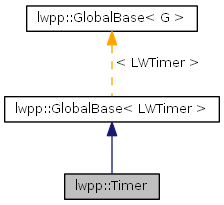
 Inheritance diagram for lwpp::Timer:
 Collaboration diagram for lwpp::Timer: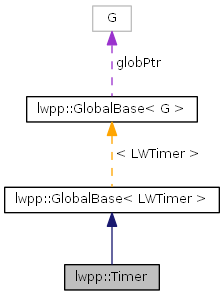
Public Member Functions | |
| template<typename T > | |
| void | addTimer (T *host, unsigned long interval) |
| virtual bool | available () const |
| Check if the global is available. | |
| virtual LWTimer * | getGlobal () |
| Get the pointer to the global. | |
| LWTimer * | operator-> () |
| Get the pointer to the global. | |
| template<typename T > | |
| void | removeTimer (T *host, unsigned long interval=0) |
Protected Member Functions | |
| bool | _acquireGlobal () |
Static Protected Attributes | |
| static LWTimer * | globPtr |
| Pointer to the global functions. | |
Detailed Description
Adds timer based events to LightWave.
The functions expect the adress of a class that implements a member function with the signature "bool TimerEvent()". This functions returns true if it should be removed, false if it shall be called again after the next interval.
Member Function Documentation
|
inlineprotectedinherited |
|
inline |
- Parameters:
-
*host callback class for timer expiration. This must have a bool TimerEvent() function implemented interval timeout value expressed in milliseconds
|
inlinevirtualinherited |
Check if the global is available.
|
inlinevirtualinherited |
Get the pointer to the global.
|
inlineinherited |
Get the pointer to the global.
|
inline |
Timers can be explicitly removed by calling the following function and specifying the 'host' as well as an optional interval. If interval is 0, then the first instance of a timer with 'proc' as its callback will be removed. If interval is >0, then only the 'proc' instance with that interval will be removed.
Unless the timer instance implicitly removes itself by returning 1 from its callback function, each call to timerAdd() MUST HAVE a corresponding call to timerRemove(), Otherwise you run the risk of leaving a dangling function pointer within Layout, which can (and probably will) eventually lead to a crash of the application.
- Parameters:
-
*host callback class for timer expiration. This must have a int TimerEvent() function implemented interval timeout value expressed in milliseconds (same used for timerAdd())
Member Data Documentation
|
staticprotectedinherited |
Pointer to the global functions.
The documentation for this class was generated from the following file: